Synthetic dataset containing the initial number of susceptible, exposed, infected, and recovered cattle (individuals) across 1,600 cattle herds (nodes). Provides a heterogeneous population structure for demonstrating SEIR model simulations in a compartmental modeling context.
Value
A data.frame with 1,600 rows (one per node) and 4
columns:
- S
Number of susceptible cattle (individuals) in the herd (node)
- E
Number of exposed cattle (individuals) in the herd (node) (all zero at start)
- I
Number of infected cattle (individuals) in the herd (node) (all zero at start)
- R
Number of recovered cattle (individuals) in the herd (node) (all zero at start)
Details
This dataset represents initial disease states in a population of 1,600 cattle herds (nodes). Each row represents a single herd (node), derived from a synthetic population structure by adding an exposed compartment to the SIR model framework.
The data contains:
- S
Total susceptible cattle (individuals) in the node
- E
Total exposed cattle (individuals) (initialized to zero)
- I
Total infected cattle (individuals) (initialized to zero)
- R
Total recovered cattle (individuals) (initialized to zero)
The herd size distribution is synthetically generated to reflect heterogeneity typical of large-scale populations, making it suitable for illustrating how to incorporate scheduled events in the SimInf framework.
See also
SEIR for creating SEIR models with this
initial state and events_SEIR for associated
movement and demographic events
Examples
## For reproducibility, call the set.seed() function and specify the
## number of threads to use. To use all available threads, remove the
## set_num_threads() call.
set.seed(123)
set_num_threads(1)
## Create a 'SEIR' model with 1600 cattle herds (nodes) and initialize
## it to run over 4*365 days. Add ten exposed animals to the first
## herd. Define 'tspan' to record the state of the system at weekly
## time-points. Load scheduled events for the population of nodes with
## births, deaths and between-node movements of individuals.
u0 <- u0_SEIR()
u0$E[1] <- 10
model <- SEIR(
u0 = u0,
tspan = seq(from = 1, to = 4*365, by = 7),
events = events_SEIR(),
beta = 0.16,
epsilon = 0.25,
gamma = 0.01
)
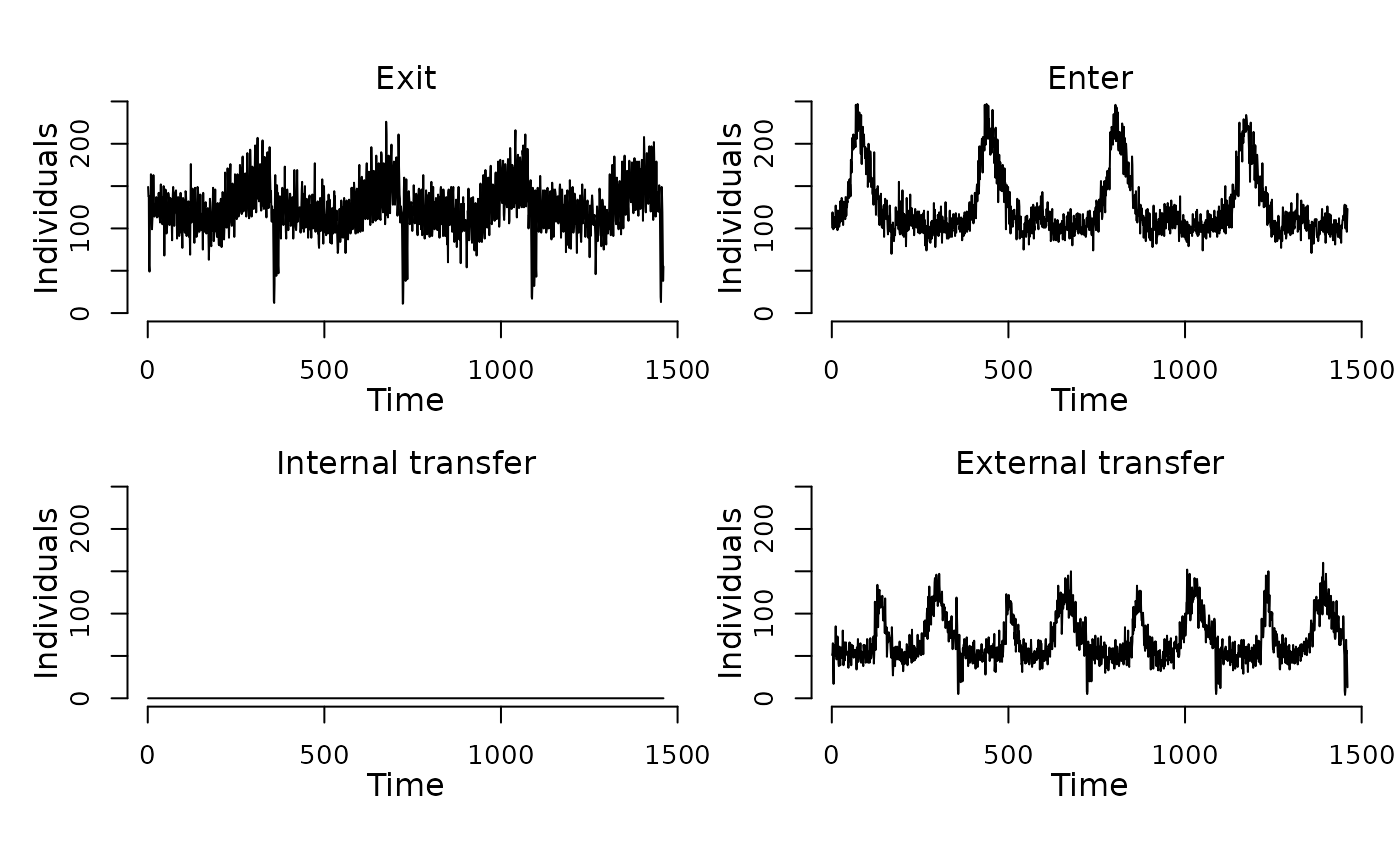
## Display the number of cattle affected by each event type per day.
plot(events(model))
 ## Run the model to generate a single stochastic trajectory.
result <- run(model)
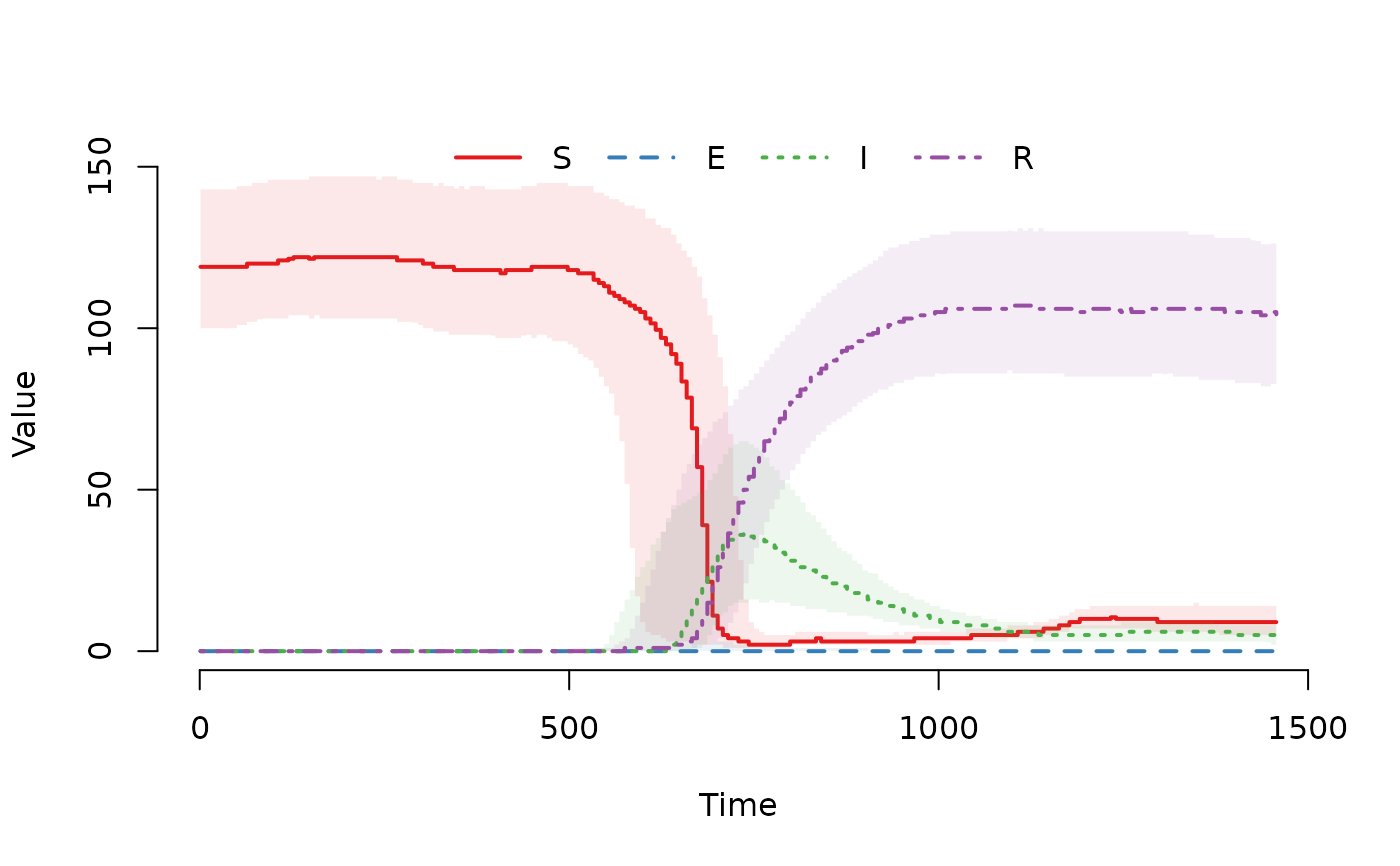
## Plot the median and interquartile range of the number of
## susceptible, exposed, infected and recovered individuals.
plot(result)
## Run the model to generate a single stochastic trajectory.
result <- run(model)
## Plot the median and interquartile range of the number of
## susceptible, exposed, infected and recovered individuals.
plot(result)
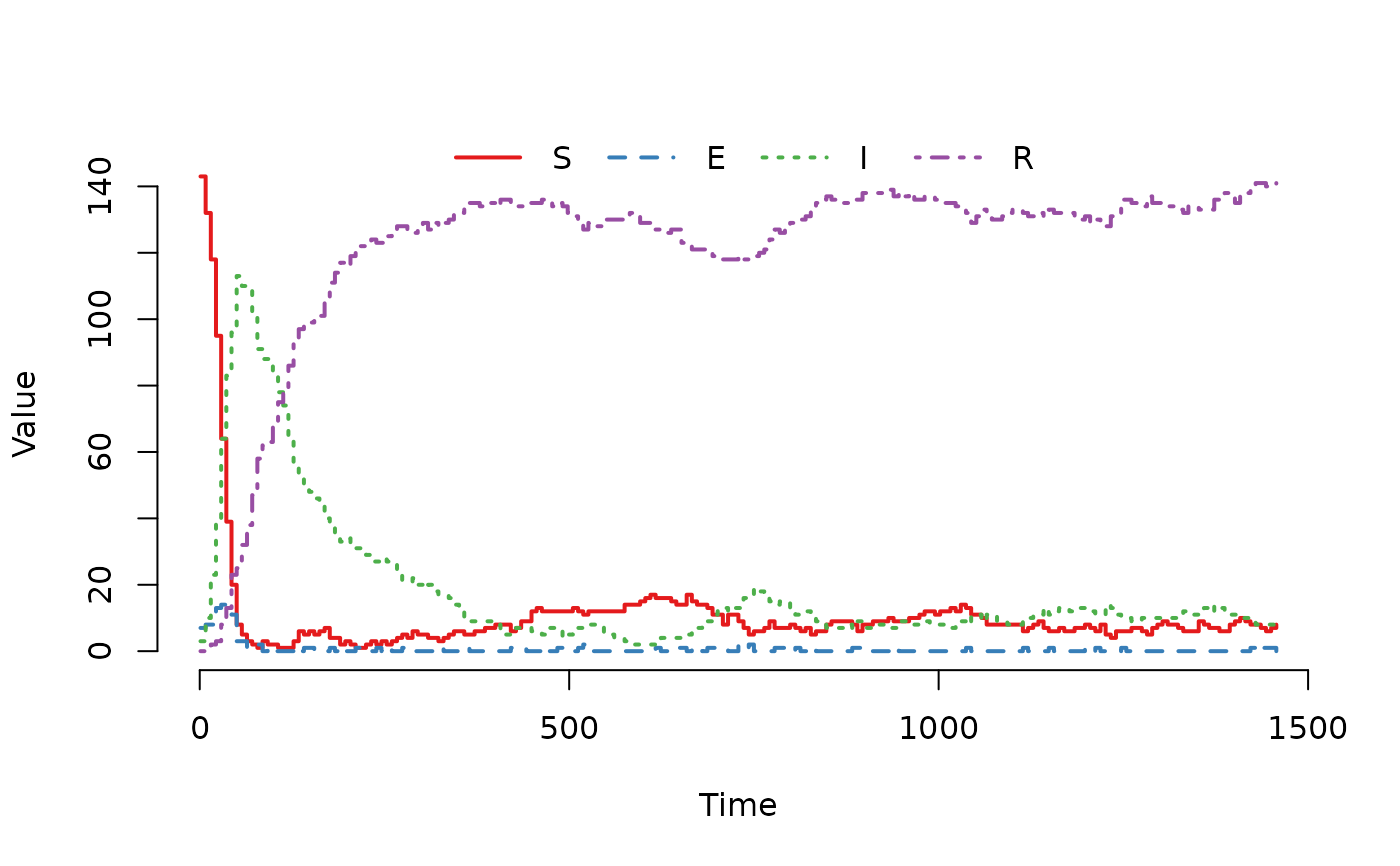
 ## Plot the trajectory for the first herd.
plot(result, index = 1)
## Plot the trajectory for the first herd.
plot(result, index = 1)
 ## Summarize the trajectory. The summary includes the number of events
## by event type.
summary(result)
#> Model: SEIR
#> Number of nodes: 1600
#>
#> Transitions
#> -----------
#> S -> beta*S*I/(S+E+I+R) -> E
#> E -> epsilon*E -> I
#> I -> gamma*I -> R
#>
#> Global data
#> -----------
#> Number of parameters without a name: 0
#> - None
#>
#> Local data
#> ----------
#> Parameter Value
#> beta 0.16
#> epsilon 0.25
#> gamma 0.01
#>
#> Scheduled events
#> ----------------
#> Exit: 182535
#> Enter: 182685
#> Internal transfer: 0
#> External transfer: 101472
#>
#> Network summary
#> ---------------
#> Min. 1st Qu. Median Mean 3rd Qu. Max.
#> Indegree: 40.0 57.0 62.0 62.1 68.0 90.0
#> Outdegree: 36.0 57.0 62.0 62.1 67.0 89.0
#>
#> Compartments
#> ------------
#> Min. 1st Qu. Median Mean 3rd Qu. Max.
#> S 0.000 5.000 16.000 59.852 116.000 217.000
#> E 0.000 0.000 0.000 0.466 0.000 35.000
#> I 0.000 0.000 3.000 10.628 11.000 161.000
#> R 0.000 0.000 47.000 53.588 101.000 214.000
## Summarize the trajectory. The summary includes the number of events
## by event type.
summary(result)
#> Model: SEIR
#> Number of nodes: 1600
#>
#> Transitions
#> -----------
#> S -> beta*S*I/(S+E+I+R) -> E
#> E -> epsilon*E -> I
#> I -> gamma*I -> R
#>
#> Global data
#> -----------
#> Number of parameters without a name: 0
#> - None
#>
#> Local data
#> ----------
#> Parameter Value
#> beta 0.16
#> epsilon 0.25
#> gamma 0.01
#>
#> Scheduled events
#> ----------------
#> Exit: 182535
#> Enter: 182685
#> Internal transfer: 0
#> External transfer: 101472
#>
#> Network summary
#> ---------------
#> Min. 1st Qu. Median Mean 3rd Qu. Max.
#> Indegree: 40.0 57.0 62.0 62.1 68.0 90.0
#> Outdegree: 36.0 57.0 62.0 62.1 67.0 89.0
#>
#> Compartments
#> ------------
#> Min. 1st Qu. Median Mean 3rd Qu. Max.
#> S 0.000 5.000 16.000 59.852 116.000 217.000
#> E 0.000 0.000 0.000 0.466 0.000 35.000
#> I 0.000 0.000 3.000 10.628 11.000 161.000
#> R 0.000 0.000 47.000 53.588 101.000 214.000